Algebra Access Parent Preview
How we help neurodiverse 8th–9th graders move from “I can’t” to steady math confidence—without shortcuts or nightly battles.

What you’ll see in this video: why the struggle is happening, what actually works for neurodiverse learners, and the roadmap we use to rebuild foundations so Algebra finally starts to stick.
Algebra Access Program Details
🔷 Who is it for?
This is for you if your child is in 8th–9th grade Pre-Algebra or Algebra 1 and:
They’re bright and trying hard, but math still doesn’t hold—especially when it’s multi-step, abstract, timed, or word-problem heavy.
You’re seeing shutdown (avoidance, tears, anger, “I don’t care,” refusing to participate)—not laziness, but self-protection.
The pattern looks like Swiss-cheese learning: sometimes they can do it with help… then it collapses when the format changes or they’re on their own because it has too many holes.
You’ve already tried tutoring, extra help, IXL/worksheets, accommodations, “more practice,” and it still hasn’t solved the real issue.
Their learning profile includes things like dyscalculia, ADHD, dyslexia, weak working memory, slow processing speed, executive-function challenges, and/or math anxiety.
Not for you if…
You want last-minute test prep or a quick grade bump without rebuilding foundations.
You’re looking for tricks/shortcuts instead of understanding.
You can’t support basic follow-through (protecting the schedule + light reinforcement when needed).
🔷 What You'll Learn in the Video
Why “bright but stuck” happens in Pre-Algebra/Algebra: fragile foundations + overload under pressure + instruction that didn’t match how they learn.
What your child needs instead of “more math”—the right things in the right order, with meaning before memorization.
How confidence actually returns: real, recent wins that stick under pressure (not pep talks).
🔷 The MathBridge Method™
The 4-step bridge from “I can’t” to steady math confidence:
Map: Find the real breakdown point
Spark: Create early wins on purpose
Build: Hands-on → visual → symbolic
Sustain: Fade support, build independence
This isn’t “more math.” It’s a different way of learning math that finally sticks.
Step 1: Map
Most families start with the meltdown topic. Tonight’s homework. The quiz. The unit they’re behind on.
But when we treat symptoms, we miss the source—so the “help” becomes more explaining, more time, more practice… and the same freeze/shutdown shows up again tomorrow.
What we do instead: we map what’s stable, what’s shaky, and what triggers shutdown (multi-step, speed, word problems, mental math)—so we stop guessing and support in the right order.
Step 2: Spark
Most students try to power through by memorizing steps or doing more problems until it sticks.
But neurodiverse learners often hit working-memory overload—and when anxiety kicks in, access shuts down even when they’re trying hard.
What we do instead: we engineer early, repeatable wins using what they already understand to light up the next idea—so they get the first: “Oh… maybe I can do this.”
Step 3: Build
Most support focuses on steps and speed.
But without meaning, math stays abstract and slippery—so it collapses under time pressure, new formats, and multi-step problems.
What we do instead: multi-sensory CRA instruction (hands-on → visual → symbolic) with the right scaffolds—so the “why” clicks, working memory strain drops, and skills transfer to class/tests.
Step 4: Sustain
Most people assume “got it once” means it should stick.
But neurodiverse learners often need spaced practice and supports that fade gradually—or the cycle returns (one rough quiz → “I’m lost again” → shutdown).
What we do instead: keep practice intentional, revisit key skills over time, and fade supports only when they’re truly ready—so progress holds in real school situations.
🔷 What's Included
Your Enrollment Includes:
✅ Dedicated Support
You’ll be paired with our Director of Client Experience, who handles schedules, invoices, and communication—so you’re never chasing emails and your child’s support stays consistent even when life gets messy.
✅ Four 1–1 Bridge Sessions (with Assessments)
We start with four one-on-one bridge sessions where we also run our assessments—so we can really get to know how your child thinks and learns, and they walk into the group already warmed up instead of getting dropped in cold after years of struggle.
✅ Two 55-Minute Group Sessions per Week (8 weeks or 12 weeks depending on the time of year | max 6 students)
Your child joins two small-group sessions each week focused on key Pre-Algebra/Algebra 1 skills using explicit, multi-sensory instruction—so they get enough time, repetition, and interaction to actually understand concepts and finally feel like they “get” what’s going on in math instead of just trying to survive class.
✅ Weekly Homework + Feedback
Each week your child receives one short, targeted assignment tied directly to what we did in group, plus feedback from their tutor—so they practice just enough to build clarity without overwhelm and start experiencing small wins at home instead of nightly homework battles.
✅ Weekly Office Hours (30 minutes)
A weekly 30-minute drop-in office hour for questions or tricky problems—so there’s a built-in safety net between sessions instead of waiting a full week when they’re stuck, and your child is far less likely to spiral into “I’m totally lost again” after one bad quiz or lesson.
✅ Regular Parent Updates
Between brief after-session notes from your child’s tutor and monthly update emails from our Director of Client Experience (key dates + what’s coming), you always know where things stand—so we can adjust support before small issues become big problems, and your child gets consistent, aligned help at home, in tutoring, and at school.
✅ 1–1 Review Call in the Last 4 Weeks
Near the end of the 12 weeks, we schedule a 1–1 review call to look at progress and discuss options for what comes next—so you have a clear, individualized picture of what’s actually changed (not just a report card), and your family can choose the right next step with confidence.
✅ Multi-Sensory Kit Shipped to Your Door
We ship a multi-sensory manipulatives kit and a digital drawing tablet—so your child can build, move, and draw the math instead of holding everything in working memory, and math feels more concrete and less scary because they have something to do with it—not just stare at a blank page.
🔷 Tech Requirements
Your child will need a computer or iPad with a working mic and camera
🚫 School-issued Chromebooks do not work well with our software.
🚫 The drawing tablet is not compatible with an iPad.
🔷 Can We Keep Going After the Program Ends?
We'll decide the next right step at your 1-1 Review Session in the last 4 weeks of the session. Many families do choose to continue working with us!
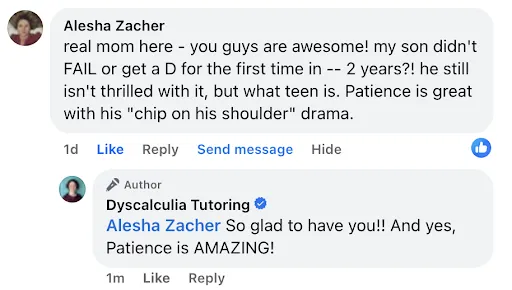
🔷 What Have Recent Parents Said?
“This program is exactly how I would have imagined it if I could for my son.” – Barbara L.
🔷 Investment
Algebra Access is designed for one outcome: your child moves from shutdown and “nothing sticks” to steady, earned math confidence—so Algebra starts making sense and holds under pressure.
We share the current investment up front so you can decide whether it’s worth exploring next steps.
Current Investment
SCHOOL YEAR: $2,300 or 4 payments of $575 for the bridge + 12 week version
SUMMER: $1,725 or 3 payments of $575 for the bridge + 8 week version (group runs July 15th - August 14th)
What this investment supports:
Higher likelihood of real progress (a full system—not random tutoring)
Faster wins that stick (we start warm and build in the right order)
Less stress at home (short practice + feedback + support between sessions)
Lower risk of backsliding (visibility, adjustments, and a safety net built in)
Next step: If it feels like the right next step for your learner, click the green button to book a call. We’ll use that time to confirm fit and map a clear plan forward. If it’s the right match, we’ll walk you through enrollment, take care of payment, and get your onboarding started.
P.S. If someone else needs to be part of the decision, please invite them—otherwise, you may leave the call with clarity, but without a next step you can act on.
P.P.S. If you are a homeschooling family, be sure to ask about our special homeschooling pricing and scheduling!
What you’ll see in this video: why the struggle is happening, what actually works for neurodiverse learners, and the roadmap we use to rebuild foundations so Algebra finally starts to stick.
Algebra Access Program Details
🔷 Who is it for?
This is for you if your child is in 8th–9th grade Pre-Algebra or Algebra 1 and:
They’re bright and trying hard, but math still doesn’t hold—especially when it’s multi-step, abstract, timed, or word-problem heavy.
You’re seeing shutdown (avoidance, tears, anger, “I don’t care,” refusing to participate)—not laziness, but self-protection.
The pattern looks like Swiss-cheese learning: sometimes they can do it with help… then it collapses when the format changes or they’re on their own because it has too many holes.
You’ve already tried tutoring, extra help, IXL/worksheets, accommodations, “more practice,” and it still hasn’t solved the real issue.
Their learning profile includes things like dyscalculia, ADHD, dyslexia, weak working memory, slow processing speed, executive-function challenges, and/or math anxiety.
Not for you if…
You want last-minute test prep or a quick grade bump without rebuilding foundations.
You’re looking for tricks/shortcuts instead of understanding.
You can’t support basic follow-through (protecting the schedule + light reinforcement when needed).
🔷 What You'll Learn in the Video
Why “bright but stuck” happens in Pre-Algebra/Algebra: fragile foundations + overload under pressure + instruction that didn’t match how they learn.
What your child needs instead of “more math”—the right things in the right order, with meaning before memorization.
How confidence actually returns: real, recent wins that stick under pressure (not pep talks).
🔷 The MathBridge Method™
The 4-step bridge from “I can’t” to steady math confidence:
Map: Find the real breakdown point
Spark: Create early wins on purpose
Build: Hands-on → visual → symbolic
Sustain: Fade support, build independence
This isn’t “more math.” It’s a different way of learning math that finally sticks.
Step 1: Map
Most families start with the meltdown topic. Tonight’s homework. The quiz. The unit they’re behind on.
But when we treat symptoms, we miss the source—so the “help” becomes more explaining, more time, more practice… and the same freeze/shutdown shows up again tomorrow.
What we do instead: we map what’s stable, what’s shaky, and what triggers shutdown (multi-step, speed, word problems, mental math)—so we stop guessing and support in the right order.
Step 2: Spark
Most students try to power through by memorizing steps or doing more problems until it sticks.
But neurodiverse learners often hit working-memory overload—and when anxiety kicks in, access shuts down even when they’re trying hard.
What we do instead: we engineer early, repeatable wins using what they already understand to light up the next idea—so they get the first: “Oh… maybe I can do this.”
Step 3: Build
Most support focuses on steps and speed.
But without meaning, math stays abstract and slippery—so it collapses under time pressure, new formats, and multi-step problems.
What we do instead: multi-sensory CRA instruction (hands-on → visual → symbolic) with the right scaffolds—so the “why” clicks, working memory strain drops, and skills transfer to class/tests.
Step 4: Sustain
Most people assume “got it once” means it should stick.
But neurodiverse learners often need spaced practice and supports that fade gradually—or the cycle returns (one rough quiz → “I’m lost again” → shutdown).
What we do instead: keep practice intentional, revisit key skills over time, and fade supports only when they’re truly ready—so progress holds in real school situations.
🔷 What's Included
Your Enrollment Includes:
✅ Dedicated Support
You’ll be paired with our Director of Client Experience, who handles schedules, invoices, and communication—so you’re never chasing emails and your child’s support stays consistent even when life gets messy.
✅ Four 1–1 Bridge Sessions (with Assessments)
We start with four one-on-one bridge sessions where we also run our assessments—so we can really get to know how your child thinks and learns, and they walk into the group already warmed up instead of getting dropped in cold after years of struggle.
✅ Two 55-Minute Group Sessions per Week (12 weeks | max 6 students)
Your child joins two small-group sessions each week focused on key Pre-Algebra/Algebra 1 skills using explicit, multi-sensory instruction—so they get enough time, repetition, and interaction to actually understand concepts and finally feel like they “get” what’s going on in math instead of just trying to survive class.
✅ Weekly Homework + Feedback
Each week your child receives one short, targeted assignment tied directly to what we did in group, plus feedback from their tutor—so they practice just enough to build clarity without overwhelm and start experiencing small wins at home instead of nightly homework battles.
✅ Weekly Office Hours (30 minutes)
A weekly 30-minute drop-in office hour for questions or tricky problems—so there’s a built-in safety net between sessions instead of waiting a full week when they’re stuck, and your child is far less likely to spiral into “I’m totally lost again” after one bad quiz or lesson.
✅ Regular Parent Updates
Between brief after-session notes from your child’s tutor and monthly update emails from our Director of Client Experience (key dates + what’s coming), you always know where things stand—so we can adjust support before small issues become big problems, and your child gets consistent, aligned help at home, in tutoring, and at school.
✅ 1–1 Review Call in the Last 4 Weeks
Near the end of the 12 weeks, we schedule a 1–1 review call to look at progress and discuss options for what comes next—so you have a clear, individualized picture of what’s actually changed (not just a report card), and your family can choose the right next step with confidence.
✅ Multi-Sensory Kit Shipped to Your Door
We ship a multi-sensory manipulatives kit and a digital drawing tablet—so your child can build, move, and draw the math instead of holding everything in working memory, and math feels more concrete and less scary because they have something to do with it—not just stare at a blank page.
🔷 Tech Requirements
Your child will need a computer or iPad with a working mic and camera.
🚫 School-issued Chromebooks do not work well with our software.
🚫 The drawing tablet is not compatible with an iPad.
🔷 Can We Keep Going After the Program Ends?
We'll decide the next right step at your 1-1 Review Session in the last 4 weeks of the session. Many families do choose to continue working with us!
🔷 What Have Recent Parents Said?
“This program is exactly how I would have imagined it if I could for my son.” – Barbara L.
🔷 Investment
Algebra Access is designed for one outcome: your child moves from shutdown and “nothing sticks” to steady, earned math confidence—so Algebra starts making sense and holds under pressure.
We share the current investment up front so you can decide whether it’s worth exploring next steps.
Current Investment
SCHOOL YEAR: $2,300 or 4 payments of $575 for the bridge + 12 week version
SUMMER: $1,725 or 3 payments of $575 for the bridge + 8 week version (group runs July 15th - August 14th)
What this investment supports:
Higher likelihood of real progress (a full system—not random tutoring)
Faster wins that stick (we start warm and build in the right order)
Less stress at home (short practice + feedback + support between sessions)
Lower risk of backsliding (visibility, adjustments, and a safety net built in)
Next step: If it feels like the right next step for your learner, click the green button to book a call. We’ll use that time to confirm fit and map a clear plan forward. If it’s the right match, we’ll walk you through enrollment, take care of payment, and get your onboarding started.
P.S. If someone else needs to be part of the decision, please invite them—otherwise, you may leave the call with clarity, but without a next step you can act on.
P.P.S. If you are a homeschooling family, be sure to ask about our special homeschooling pricing and scheduling!

What Your Child Will Learn...
#1.) The best way to ____
#2.) How to _____
#3.) Strategies to ___ .
#4.) Techniques to____
#5.) AND __.
What Your Child Will Learn...
#1.) The best way to ___.
#1.) How to __.
#2.) Strategies to ___.
#3.) Techniques to ____.
#4.) AND ___.

ABOUT [TEACHER NAME]
Lorem ipsum dolor sit amet, consectetur adipisicing elit. Autem dolore, alias,
Lorem ipsum dolor sit amet, consectetur adipisicing elit. Autem dolore, alias, numquam enim ab voluptate id quam harum ducimus cupiditate similique quisquam et deserunt, recusandae.
Lorem ipsum dolor sit amet, consectetur adipisicing elit. Autem dolore, alias, numquam enim ab voluptate id quam harum ducimus cupiditate similique quisquam et deserunt, recusandae.
Lorem ipsum dolor sit amet, consectetur adipisicing elit. Autem dolore, alias, numquam enim ab voluptate id quam harum ducimus cupiditate
About [TEACHER NAME]
Lorem ipsum dolor sit amet, consectetur adipisicing elit. Autem dolore, alias,
Lorem ipsum dolor sit amet, consectetur adipisicing elit. Autem dolore, alias, numquam enim ab voluptate id quam harum ducimus cupiditate similique quisquam et deserunt, recusandae.
Lorem ipsum dolor sit amet, consectetur adipisicing elit. Autem dolore, alias, numquam enim ab voluptate id quam harum ducimus cupiditate similique quisquam et deserunt, recusandae.
Lorem ipsum dolor sit amet, consectetur adipisicing elit. Autem dolore, alias, numquam enim ab voluptate id quam harum ducimus cupiditate
Want Your Child To [Insert Result]
Get started Today And Schedule One Of The Limited Student Success Sessions We Have available On The Next Page!
This Site Is Not A Part Of The Facebook Website Or Facebook Inc. Additionally, This Site Is Not Endorsed By
Facebook In Any Way. Facebook Is A Trademark Of Facebook, Inc.
Important: Legal Disclaimers
We Don’t Believe In Instant Or Guaranteed Result Programs. We Believe In Hard Work, Adding Value And Serving Others. And That’s What Our Programs Are Designed To Help You Do. As Stated By Law, We Can Not And Do Not Make Any Guarantees About Your Own Ability To Get Results With Our Ideas, Information, Programs Or Strategies. We Don’t Know You And, Besides, Your Results In Life Are Up To You. Agreed? We’re Here To Help By Giving You Our Greatest Strategies To Move You Forward, Faster. However, Nothing On This Page Or Any Of Our Websites Or Emails Is A Promise Or Guarantee Of Future Success. Any Results Showcased Here, Or On Any Of Our Sites Or Emails, Are Simply Projections Or Past Results, And Should Not Be Considered Exact, Actual Or As A Promise. If You Have Questions, Email: [email protected]
© Copyright 2026 - Dyscalculia Tutoring - All Rights Reserved